


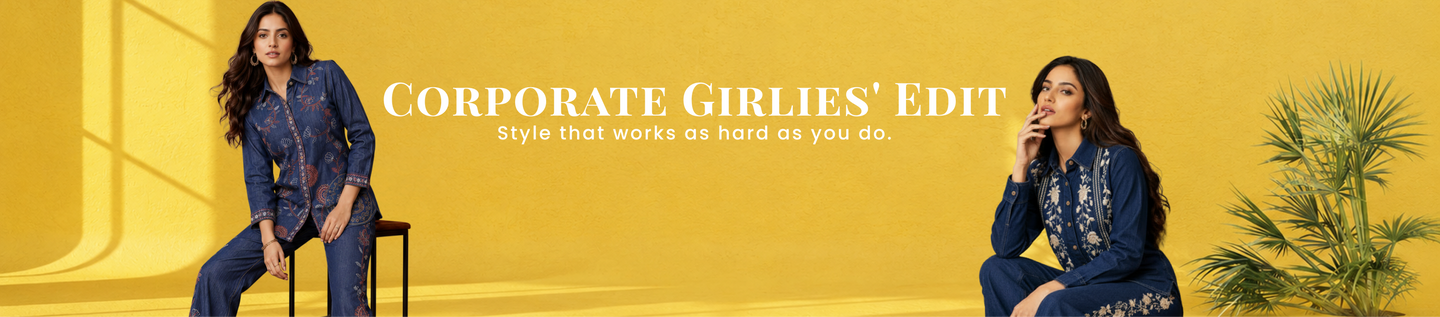
Co-Ord Sets for Women
42 products


Elegant Sky Embroidered Tunic Set for Women


Chic Purple Floral Embroidered Tunic for Women ( Collection)


Sky Blue Embroidered Co-Ord Set with Straight Kurta & Wide-Leg Pants


Vibrant Red Embroidered Co ord set


Elegant Cream Embroidered Shirt and Wide-Leg Pants Set


Black Striped Horse Print Co ord set


Vibrant Yellow Floral Print Co ord set with Cream Pants


Pista Green Co-ord Set with Unique Tree Ring Print


Elegant Cream Co ord set with Brown Floral Embroidery


Elegant Blue Printed Co-Ord Set for Women


Embroidered Rust Co ord set


Embroidered Purple Linen Co-ord Set with Tassel Details


Elegant Black Paisley Print Co ord set


Chic Pink Floral Print Cotton Co ord set


Elegant Pink Floral Print Co ord set


Elegant Wine Cape Top and Pants Set for Women


Elegant Pink Floral Print Kurta with Palazzo Pants


Blue Embroidered Cotton Co-ord Set


Green Printed Kurta and Dhoti Pants co ord Set


Elegant Black Printed co ord Set with Wide-Leg Pants


Blue Embroidered Kurta and Pants co ord Set with Geometric Border


Elegant Beige Embroidered Kurta with Dark Blue co ord set

Blue Floral Print Linen Blend Shirt and Wide-Leg Pants co ord Set


Ochre Yellow Floral Print Kurta and Palazzo co ord Set
- Featured
- Most relevant
- Best selling
- Alphabetically, A-Z
- Alphabetically, Z-A
- Price, low to high
- Price, high to low
- Date, old to new
- Date, new to old
Co-ord Sets for Women — Buy Designer Co-ord Sets Online
A co-ord set is two or more pieces cut from the same fabric and finished in the same print or embroidery, made to be worn together. The matching is already done: colour, print scale and fabric weight agree before you reach the till.
Our range runs from printed cotton and linen for an Indian summer to embroidered silk and organza for a festive lunch. The bottom is usually a trouser rather than a skirt, which is why a co-ord set moves easily from office desk to family dinner.
What is a co ord set?
The name is short for co-ordinated set: a top and a bottom cut from one cloth — a straight kurta over pants, or a shirt over wide-leg trousers. The test of a good one is that each piece still works alone; if it only works as a set, you will wear it less than you think.
Co ord set vs kurti set vs sharara: what is the difference?
A kurti set is built around a long tunic with pants and usually a dupatta, and those pieces only need to co-ordinate — a plain bottom under a printed kurti still counts. A co-ord set is stricter: the fabric and print are shared, and the top is as often a shirt or a short kurta as a long one. Browse kurti sets for the longer tunic.
A sharara pairs a short kurti with trousers that fit to the knee and then flare hard; it exists for mehndi nights and weddings, where a co-ord set is built for ordinary days first. An indo-western outfit applies Indian craft to a Western cut, with no rule that the pieces match; a gown is a single garment, so matching never arises.
Ethnic co ord set fabrics: cotton, linen, silk and organza
Cotton
Cotton breathes, absorbs sweat and does not cling in humidity — the sane choice for an Indian summer. It creases — not a fault, just what the fibre does. Muslin, a fine loosely woven cotton, is softer and improves with every wash.
Linen
Linen runs cooler than cotton and dries faster, and hangs in a crisp column rather than falling soft against the body. It wrinkles visibly, reading relaxed rather than sharp — good for daytime and travel.
Silk
Silk has weight and a low sheen. It drapes close, holds a pleat and photographs well under indoor lighting, which earns its place at evening functions. It is warmer than cotton and does not forgive water marks.
Organza
Organza is sheer, stiff and light. It stands away from the body instead of following it, giving a sleeve volume without weight. Choose it for structure among soft drapes; it is nearly always lined.
Coord set women: which silhouette suits your body shape?
A straight top over straight pants draws one long vertical line and lengthens the frame — the safest first buy. A shirt with wide-leg trousers balances broader shoulders, since the volume sits low. Palazzo bottoms swing more and skim the hip rather than gripping it. Dhoti-style bottoms pull the eye to the waist and shorten the leg line, rewarding a taller frame or a heel. When a set is sold as one size, buy for your widest measurement and have the other piece taken in; a tailor narrows a trouser far more easily than they let out a sleeve.
Matching set colours for haldi, mehndi, sangeet and office
Yellow belongs to haldi and photographs well in daylight. Green is the mehndi shade and sits beside the henna instead of fighting it. Sangeet rewards the brighter end — pink, purple, wine — because those evenings are lit artificially. A reception asks for something deeper: black, wine, or a blue with sheen. For a puja, cream, beige and soft blue are the quiet choices. For office, grey and beige in a print small enough to read as texture serve better than anything loud.
How to style a matching set: jewellery, footwear and bag
A printed set is already busy, so keep the jewellery quiet — small studs, a thin bangle stack, nothing at the neck. A plain or embroidered set has room for a statement: oxidised silver against cotton and linen, gold or kundan against silk. Footwear follows the bottom — juttis under a straight pant, a block heel under a palazzo so the hem clears the floor, flats under a dhoti. Carry a structured sling or potli; a slouchy tote fights the set's clean lines.
How to wash and store a co ord set
Cotton and linen take a cold gentle machine wash, inside out, mild detergent, no bleach. Wash both pieces together every time, even when only one of them is dirty — once two pieces fade at different rates the set stops matching. Send silk and organza to a dry cleaner, and never dry any of these in direct sun, which strips colour faster than washing. Store the set on one hanger, and keep organza and heavy embroidery in a muslin bag rather than plastic, which traps moisture.
More from Shree Shivam
Shree Shivam has sold Indian ethnic and bridal wear for over a decade. For a wedding rather than a weekday, our lehenga cholis and sarees cover the heavier end, with kurta pajama for the men and ethnic wear for girls. Every order ships free across India with a seven-day return window.
FAQs
What is the difference between a co-ord set and a kurti set?
A kurti set is built around a long tunic worn with pants and usually a dupatta, and those pieces only need to co-ordinate — a plain bottom under a printed kurti still counts. A co-ord set is stricter: the pieces share the same fabric and the same print or embroidery, and the top is as often a shirt or a short kurta as a long one.
Which co-ord set fabric is best for Indian summer?
Cotton and linen. Both breathe and let sweat evaporate instead of holding it against the skin, so they do not cling in humidity. Linen runs slightly cooler and dries faster but wrinkles more visibly; cotton creases too, which is simply what the fibre does. Silk and organza are warmer and better kept for evening functions.
Can I wear a co-ord set to a wedding?
Yes, for the daytime and lighter events — a mehndi morning, a puja, a haldi, a family lunch. Choose an embroidered set in silk or organza rather than a printed cotton one. For the ceremony itself or a reception, a lehenga choli or a saree carries the weight the occasion expects.


